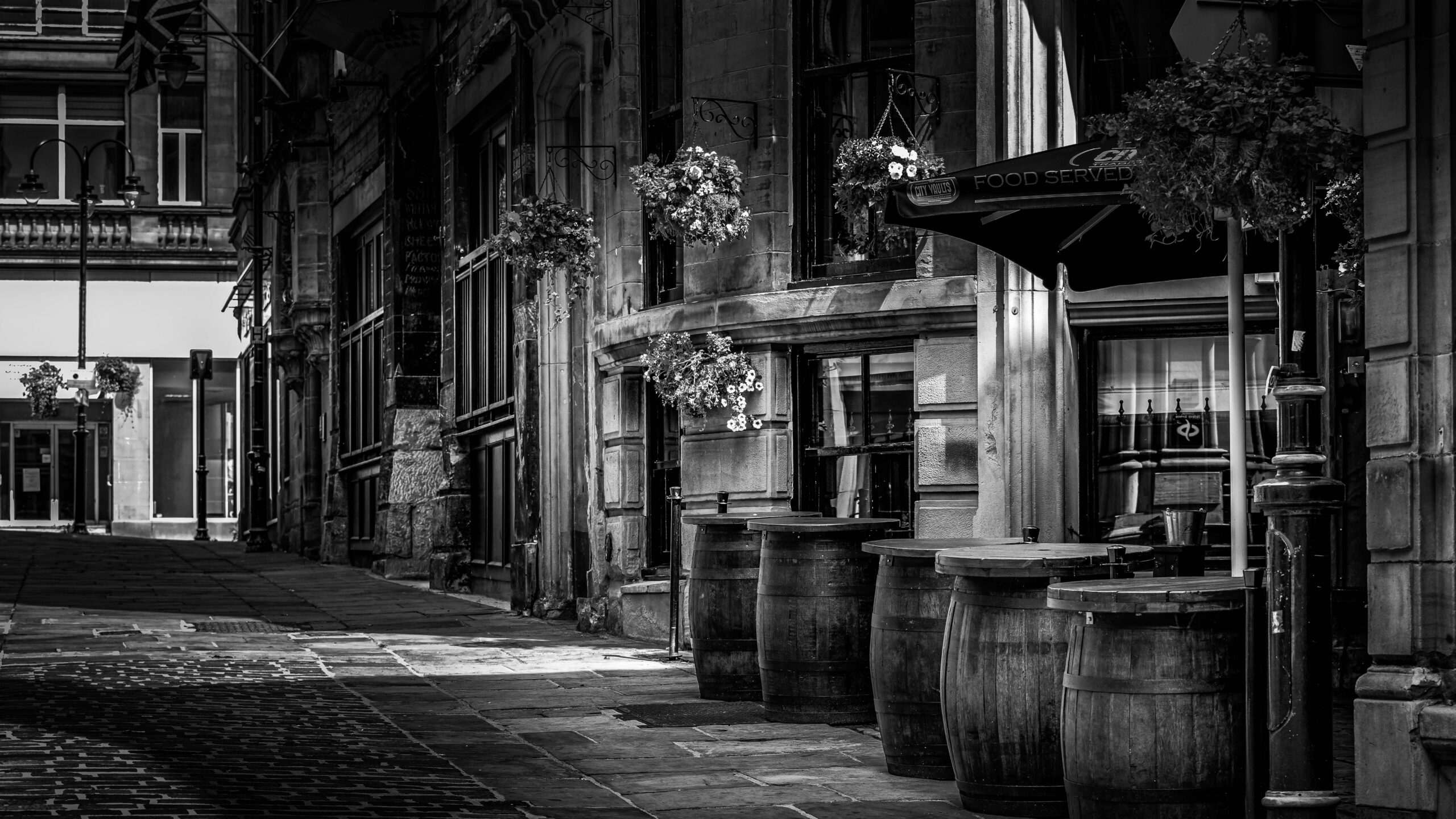
Not every photograph begins with a spectacular place.
Sometimes it begins with a wall, a shadow, an empty street, a person passing through light, a chair near a window, a quiet corner of a city, or a landscape that does not look impressive at first.
These are the frames that are easy to ignore.
They do not shout for attention. They do not look like postcards. They do not always make sense immediately.
But often, they are the photographs that stay with me.
Because they ask for something different.
They ask you to slow down.
Looking past the obvious
When we start photography, it is natural to look for obvious subjects.
Beautiful mountains. Famous streets. Big views. Interesting buildings. Dramatic skies.
There is nothing wrong with that. I still love those moments. Sometimes a place is powerful because it is visually impressive, and the photograph almost begins before you lift the camera.
But if we only photograph what is already obvious, we can miss a different kind of image.
The quieter one.
The one hidden inside normal life.
A frame does not need to be spectacular to be meaningful. Sometimes it only needs one thing: light falling in the right place, a shape that feels balanced, a small detail that creates mood, or a silence that is difficult to explain.
That is where the ordinary frame begins.
Ordinary does not mean boring
I used to think that if a place was ordinary, the photograph would be ordinary too.
But photography has changed the way I understand that word.
Ordinary does not mean empty.
It means familiar.
It means overlooked.
It means the scene has not yet been separated from daily life.
A street you walk often. A corner you pass without thinking. A building you stop noticing because it is always there. A landscape that feels too close to home to seem special.
But the camera can change that relationship.
Not by making the place fake or dramatic, but by asking you to look again.
What happens if you wait for the light?
What happens if you remove everything unnecessary from the frame?
What happens if you notice the shadow instead of the object?
What happens if you photograph the feeling rather than the subject?
Sometimes the ordinary becomes interesting because you finally give it attention.
The photograph is often already there
One of the most important things I have learned is that photography is not always about finding more.
Sometimes it is about removing.
Removing noise.
Removing hurry.
Removing the need for the scene to be impressive.
Removing the pressure to come back with something.
When I slow down, I often realise the photograph was already there.
It was in the way light touched the pavement.
In the distance between two figures.
In the shape of a window.
In the contrast between a small human presence and a large space.
In the quiet mood of a place before anything dramatic happened.
The frame was not missing.
My attention was.
Why ordinary scenes can feel more honest
There is a kind of honesty in ordinary photographs.
They are not trying too hard to impress. They do not depend only on the fame of a location. They do not ask the viewer to admire the place before they feel the image.
They rely on mood, timing, composition, and observation.
That makes them personal.
Two photographers can stand in front of the same famous landmark and make similar images. But two photographers walking through an ordinary street may notice completely different things.
One sees geometry.
One sees loneliness.
One sees colour.
One sees humour.
One sees silence.
This is where personal style begins to show. Not only in the big moments, but in the small decisions about what you choose to notice.
Not every image is rewarded immediately
One difficult part of sharing photography today is that we often wait for a reaction.
We post an image and hope it connects. Sometimes we expect more from a photograph because we know what it meant to us — the effort, the place, the waiting, the feeling behind it.
And sometimes nothing much happens.
That can make you question the image.
But I do not think every photograph should be judged only by the reaction it receives online. Some images are quieter. Some need more time. Some are important because they helped you see something, even if they do not perform well.
The ordinary frame may not always be the most obvious image.
It may not always be the one that gets the most attention.
But it can still be the one that teaches you the most about how you see.
The role of light
Light can turn an ordinary scene into a photograph.
A normal wall becomes a study of shadow.
A simple street becomes cinematic in the evening.
A quiet room becomes emotional when light touches only one corner.
A landscape becomes softer when clouds move across it.
This is why I try not to dismiss a place too quickly.
Sometimes the subject is not ready yet.
Sometimes the light has not arrived.
Sometimes the photograph needs five more minutes.
And sometimes nothing happens at all.
That is part of it too.
Photography teaches patience because it does not always reward you immediately. But the more you watch, the more you learn how ordinary places change.
Composition as attention
I do not think composition is only about rules.
Rules can help, especially in the beginning. But the deeper question is not always whether the image follows a rule.
The question is: where does the eye rest?
What matters in the frame?
What is distracting from it?
Where does the light lead you?
What should be included?
What should be left outside?
In ordinary scenes, composition becomes even more important because there is less obvious drama to rely on.
You have to decide what the photograph is really about.
Sometimes moving one step to the left changes everything.
Sometimes waiting for one person to enter the frame gives the image scale.
Sometimes removing the sky makes the photograph stronger.
Sometimes the quietest part of the scene is the reason to take the picture.
Training yourself to notice
The ordinary frame is not something you find once.
It is something you train yourself to see.
You can practise it anywhere.
On the way to work.
On a short walk.
In your neighbourhood.
Inside your home.
In a city you already know too well.
During a day when nothing special seems to be happening.
The exercise is simple:
Choose one ordinary place and stay with it longer than usual.
Look at the light.
Look at the shapes.
Look at what enters and leaves the frame.
Look at the background.
Look at the quiet detail you first ignored.
Do not ask the place to become amazing.
Ask yourself to become more attentive.
That is different.
I still miss things
I do not write this because I always see everything.
I don’t.
There are many times I walk past a scene and only realise later that there was something there. There are days when I feel distracted, tired, or too much inside my own head to notice properly. There are moments when I force a photograph instead of waiting, or ignore something simple because I am looking for something more obvious.
That is part of the practice.
The point is not to become someone who sees perfectly all the time.
The point is to keep returning to attention.
Photography keeps teaching me that seeing is not a fixed talent. It changes with our energy, our patience, our mood, and the way we move through the world on that day.
Some days we see more.
Some days we see less.
But every time we slow down, we give ourselves a better chance.
The image after the image
Sometimes an ordinary photograph becomes more meaningful later.
At the time, it may feel small. Just a quiet frame. A simple observation. A moment that almost did not seem worth keeping.
But later, it can carry a feeling.
A season of life.
A walk you took.
A city you lived in.
A mood you did not understand at the time.
A small piece of a place that no longer looks the same.
Not every photograph needs to announce its importance immediately.
Some images reveal themselves slowly.
And often, those are the ones that feel closest to memory.
A small invitation
The next time you go out with a camera, try not to search only for the obvious photograph.
Look for the ordinary frame.
The one that does not ask for attention.
The one hidden in plain sight.
The one shaped by light, silence, space, or a small human moment.
You may not come back with a dramatic image.
But you may come back with something more personal.
A photograph that says less about where you were, and more about how you saw.
If this way of seeing speaks to you, The Quiet Photographer goes deeper into building a calmer creative rhythm — through small habits, observation, and creating without pressure.